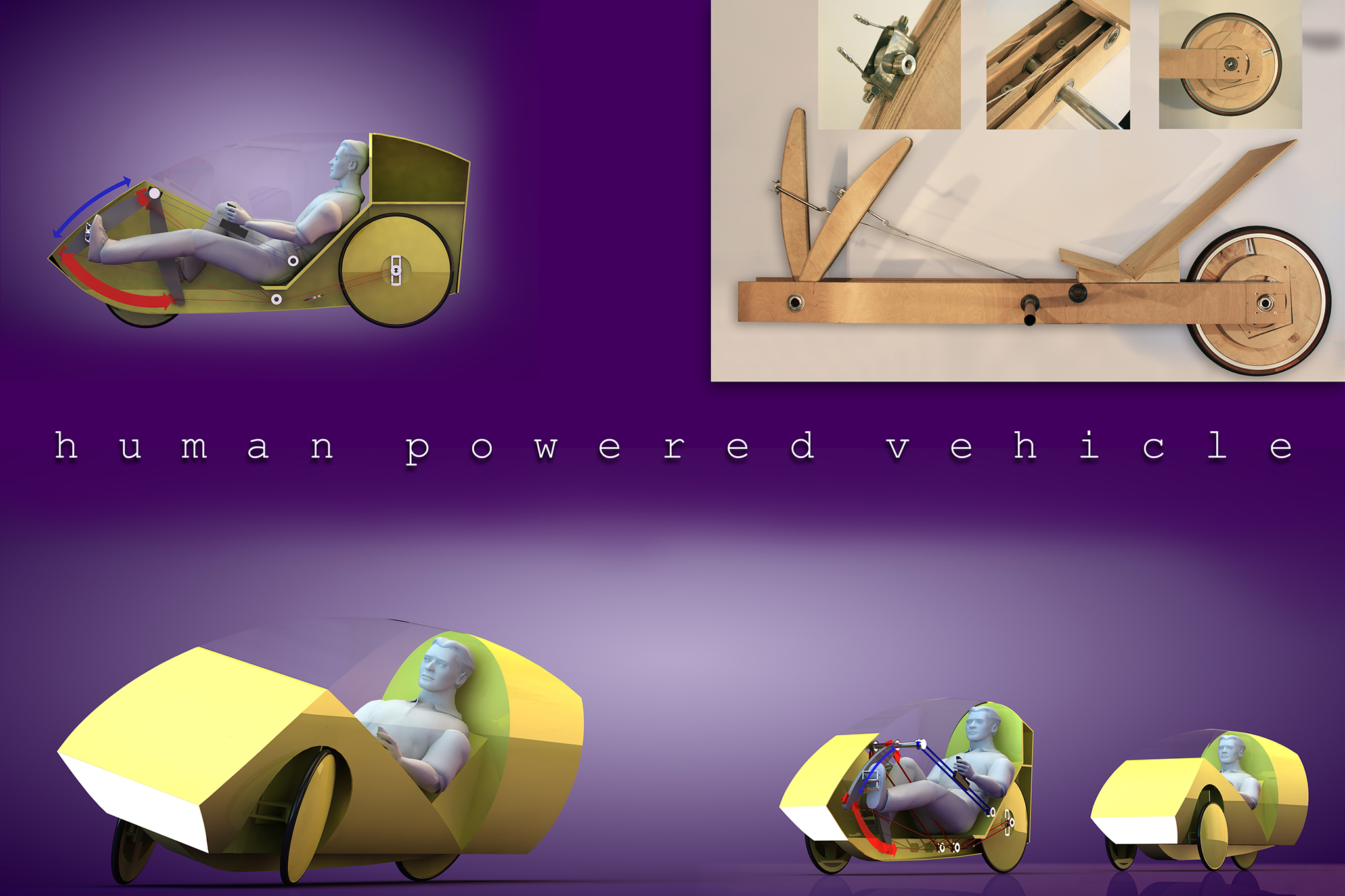
With the same effort, the resulting speed can be optimised.
Overcoming air resistance:
In the normal “bike position” (almost upright posture) without an aerodynamic shape, we need over seventy percent of the power applied to overcome air resistance
(Large cross-section in the wind, lots of turbulence around the structure).
With a seated body position and an opening angle of 125 degrees between torso and legs, the cross-section in the wind is minimised (approx. 60 x 60 cm).
A compact aerodynamic fairing guides the airflow around the vehicle with as little turbulence as possible (optimising the drag coefficient).
Optimal power transmission
With the usual circular pedal motion, the leg pushes on the pedal with full force at only one point, namely when the pedal is horizontal and the force is applied exactly perpendicular to it.
By pushing a long lever, the full force is actually transmitted to the wheels over almost the entire stroke.
3 wheels
The vehicle stands up by itself even when stationary, so you don’t have to put a foot down when stopping.
Thanks to the tilting technology, the vehicle nevertheless behaves as favourably as a two-wheeler: it leans into the curve, which allows higher cornering speeds and also almost rules out tipping over. It also avoids the unpleasant feeling of lateral acceleration forces.
Disadvantage: more complicated, more parts, more expensive, more rolling-resistance losses.
Fairing
The vehicle is not a tubular frame that is clad afterwards. The fairing is the structure and thus also the load-bearing frame (as in modern car and aircraft construction etc.) and is therefore very torsionally stiff. Today this shell would probably be made of carbon.
Advantages: very stable, streamlined, protects in the rain (thanks to the three wheels, i.e. standing at the traffic light without having to support yourself with a foot, you stay completely dry). A closed “boot” can be placed behind the seat (part of the aerodynamic shape). All the mechanics are also kept dry.
Side effects:
Continuously variable gearing
Anti-reverse lock
Simple mechanics
Large lights without a tangle of cables that could only break.
All the mechanics are kept “dry” and enclosed, and therefore practically maintenance-free
Indicators
Braking energy recovery directly in the wheels (flywheel, spring)
A novel wheel construction allows the wheel to be removed and the tube and tyre to be changed without tools.